Auto News
3 Best Wireless Dash Cam for Car

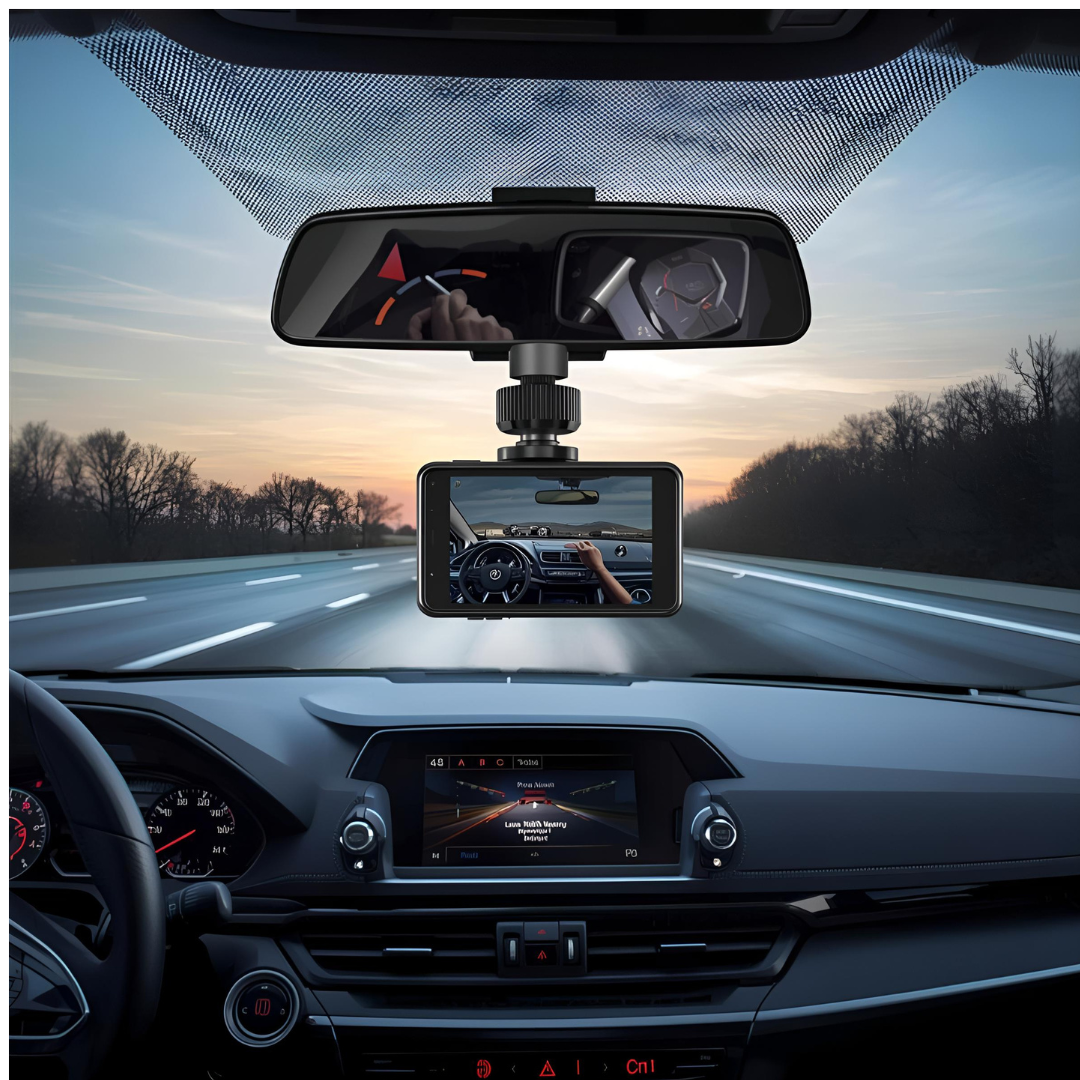
Without wires across a dash cam, wireless dash cams have totally changed how drivers record incidents and protect themselves. The best wireless dash cam for cars has a good number of special features, like a mix of 4K video. GPS and app control.
Best wireless dash cam for cars includes the Vantrue E1 Pro if you want to go for an affordable dash cam, if you want a premium quality dash cam, go for the Viofo A229 Pro/A329S. Whereas, if you want a dash cam for a car with special features like rotating head, go for 70mai Omni. Generally, dash cam for cars offers a wide range of benefits like giving insurance discounts, protection against vandalism, and also provides a video on accident claims.
Dash cam cameras for cars also capture unique road experiences. For selection of best cam cameras for cars, go for key features like night vision, channels, video resolution and GPS. This blogpost provides the benefits of the best wireless dash cam, the key features to consider when buying it, the pros and cons of the best wireless dash cam and more. By the end of this blogpost, you will be able to make a good choice on the best wireless dash cam for cars.
ABOUT WIRELESS DASH CAM FOR CAR
A wireless dash cam for cars is a sure way to secure yourself and keep yourself safe. They collect accident evidence, in addition to recording beautiful travelling experiences. A wireless dash cam for cars is a car camera system that is used for cloud backup, and transferring video footage through the use of wireless communication. By using cellular connectivity, you can transfer footage or videos to your phone with your wireless dash cam. Where can a wireless dash cam be placed? This video recording camera can be placed on the dashboard or the windshield of a car. This way you can record your videos even while driving.
CATEGORIES WIRELESS DASH CAM FOR CAR
There are two key categories of wireless dash cam for cars. They are:
- Battery-Powered, Wireless Dash Cams: This category of wireless dash cam, uses a rechargeable internal battery. They are very portable and easy to install.
- Wi-Fi Powered Dash Cam: This category of dash cam needs a power source that is constant. The wires are neatly connected.
HOW WIRELESS DASH CAM FOR CAR WORKS
Dash cams are quite easy and simple to use. They consist of a camera, a bracket for mounting it and a memory card of choice for recording data. In some models, the dash cam automatically comes on once the car’s engine is turned on. Wireless dash cam for cars uses either internal batteries or other constant power source and a cellular connection to send image or video footage without any wired connection to your device.
– Power: Some models of the wireless dash cam use batteries or supercapacitors while others are wired power.
– Storage: Wireless dash cam for cars uses SD Card for local storage. It also uses Cloud or special apps storage is also another good storage option to secure footage from being stolen and lost.
– GPS FUNCTIONS: With its special built-in GPS features, you can log in your location, route and speed with your wireless dam cam for the car.
Related Post:Catalytic Converter Transmission Cost
HOW TO MOUNT A WIRELESS DASH CAM
Do the following, to mount a dash cam:
– Arrange for a good mounting position: You may choose to mount your dash cam near or behind your car’s rear mirror. Whatever your choice is, make sure the lens of your camera has a clear view of the road.
– Use cleans wipes to clean the windshield, so that the adhesive will still well
– Use a bracket to attach a dash cam to your car’s dashboard or the windshield.
– Power the camera by connecting the provided bracket to a USB port for power. In other models, you can connect your dash cam directly to your car battery.
– Pair the camera with the App, by following the pairing steps on the app.
– Adjust GPS, resolution and also the date and time to suit you.
– Go for a short drive, to test the camera.
USES OF A DASH CAM FOR CAR
The demand for dash cams for cars has become increasingly great in recent years. The dash cams provide a good level of both convenience and safety for drivers. Other benefits of dash cam include:
– For Providing Evidence in the Case of Accidents: The images obtained from dash cam can be used as evidence in the event of accidents on road, thereby facilitating resolution of misunderstandings between car drivers involved in accidents.
– For Prevention of Insurance Fraud: This particular type of fraud case is a widespread problem in many countries today. With dash cam for cars, by simply documenting the accident, you can uncover potential fraud attempts.
– For Monitoring Parking: The technology in advanced dash cams makes it possible for modern dash cams to monitor parking lots. This feature can be used to resolve theft cases in car parks.
– For Improving Safety in Driving: The use of dash cams can encourage car users to drive more responsibly knowing their actions.
– For Recording Road Trip Experiences: This function alone makes dash cam a great tool for travel enthusiasts as it allows them to relive the fun during travelling and share the moments with family and friends.
ADVANTAGES OF USING A WIRELESS DASH CAM
The demand for wireless dash cams is increasing for the right reasons. Here are the following advantages of wireless dash cams:
– Wireless Dash Cams are Portable: You can easily uninstall your battery -powered cameras when it’s not in use.
– You can Backup Data in Cloud: Your footage can be backed up in cloud, giving you more storage space in the case of theft.
– Installation is Easy: Installation does not require the use of many long cables or hardwire. You can easily uninstall your dash cam and install it in another car.
THE EFFECT OF DASH CAM ON YOUR CAR BATTERY
One of the most common questions of the dash cam for cars is its impact on the battery life of the car. The truth is that most dash cams use only a small amount of power from the car battery compared to the amount of power used by air conditioners, car radios and other systems.
To be more specific, an average car radio consumes about 65watt, while a standard dash cam draws only about 0.5 and 2 amps of current, which is only about 6 and 25watts. This brief analysis goes to show that a dash cam has minimal impact on the battery life of a car. Where you should be more concerned is when the dash cam is used in the car for long periods without recharging the battery of the car. Still, to avoid battery problems because of the use of dash cam, it is recommended that you from time to time check the health of your car’s battery.
MAIN FEATURES TO CONSIDER WHEN BUYING THE BEST WIRELESS DASH CAM
So far, we have seen that wireless dash cams are portable surveillance cameras designed to be installed inside cars for the purpose of monitoring the exterior and interior of the car. In light of that information, let us now consider, main features you should look out for when buying a dash cam. Choosing the best dash cam is mostly about balancing features, video quality and reliability. The main features to consider when buying a wireless dash cam include:
– CLOUD STORAGE: This is one of the main features you should consider. Cloud storage protects your footage in case your camera is stolen or your physical storage device is corrupted. Some cloud storage packages come with subscription offers.
– POWER SOURCE: It is also important that you consider which power source the dash camera uses as different power sources have different capabilities. For example, battery-powered power sources on dash cams only last for a few hours, and can monitor short-stay parking.
– VIDEO QUALITY: Go for at least a full HD of 1080p with a 4K resolution that would better capture important details like faces of drivers and license plates.
– NIGHT PERFORMANCE: Evaluate the night performance of the dash cam sensors. Find out if the dash cam can function properly in a low light environment.
– CONNECTIVITY: Different connectivity has different capabilities. For example, the WIFI allows for live viewing and quick clip transfer of footage to your device. On the other hand, Bluetooth connectivity allows for pairing and less energy demanding tasks. While, cellular connectivity provides genuine remote cloud upload with a subscription plan.
– FIELD OF VIEW OF THE DASH CAM: The field of view of a dash cam, ranges from 140 degrees to 180 degrees.
– SD STORAGE: Opt for SD support of up to 128GB or more
– GPS: GPS records speed and route. Be sure to make your GPS data accessible in the app.
– APP: A functional app allows for comfort and convenience while using the dash cam.
– Other important features: Also look out for voice control to make hands-free operation possible, Dual channel (front and rear) recording and driver alerts.
Related Post:What is a Good Mileage for Used Cars ?
3 BEST WIRELESS DASH CAM FOR CARS
Next, let us consider three best wireless dash cameras. Each brief review on this, includes who can use it, pros and cons of each and the key features it has. Let’s go:
VIOFO A327 is one of the best wireless dash cameras with excellent quality of advanced 4K with 60fps video. If you are looking for a dash cam with premium performance, then you should go for the VIOFO A327.
Main Features of the VIIOFO A327 Dash Camera
– Image Sensors: This dash camera makes use of the SONY STARVIS 2 image sensors. Its front camera uses the 8MP IMX678 at the front camera. This feature reduces blur in motion objects.
– Storage Capacity: The VIOFO A327 dash camera has a special storage feature. This dash cam for cars has a massive storage that supports up to 512GB SD cards.
– Video Resolution: This dash cam for cars has front, rear and cabin cameras in 2K and 4K resolution.
– It supports voice control and notifications.
– A circular polarizing lens.
PROS OF VIOFO A329
– With the VIOFO A329, exceptional video quality is sure.
– Night performance is exceptional even with low-light.
– Expandable storage capacity that supports up to 512GB.
– It has built-in GPS.
– This dash cam has dual-band WIFI 6, which enables fast file transfer with other devices.
– Wide range of coverage with its front, rear and interior cameras.
CONS OF THE VIOFO A329
– It is quite pricey.
– No touch screen feature.
– Physical buttons do not illuminate, making it difficult to use at night.
– Installation is difficult.
Cost: You can buy VIOFO A327 on Amazon at $419.99.
If you are looking for the best dual wireless dash cam, the Vantrue N4 Pro is the best option for you. This is another wireless dash cam that uses a SONY Starvis 2 Sensor with HDR to produce quality images.
MAIN FEATURES IN VANTRUE N4 PRO
– The Vantrue N4 Pro has a triple recording feature.
– With its use of the SONY Stravis 2 sensor with HDR and WDR, night vision is clear as day.
– Depending on the model, this dash cam has a storage capacity that supports SD cards that is up to ITB.
PROS OF A VANTRUE N4 PRO
– It has advanced features that provide excellent night vision.
– With its supercapacitors power is reliable.
– Set up is much easier.
– Video quality is superb.
– The Vantru N4 Pro also has voice control features.
– This dash cam comes with a built-in GPS.
– The screen of the Vantrue N4 Pros dash cam is wide, measuring 3.2 inches.
CONS OF A VANTRUE N4 PRO
– The Vantrue N4 Pro dash cam for cars is quite pricey.
– SD card for storage and the CPL filter is sold differently. This poses a chance of them missing.
– You cannot operate using the touch screen feature to access some functions in this dash cam.
– Parking mode issues can easily drain the battery of your car.
Cost of The Vantrue N4 Pro: On Amazon you can get this dash cam at the range of $269.99 to $379.99.
The Thinkware U3000 is an excellent choice for parking surveillance with advanced parking mode.
MAIN FEATURES OF THINKWARE U3000
– Video Quality: Crystal clear video quality. It has a 4K UHD front and 2K QHD rear camera.
– It has a dual RADAR and advanced parking modes that saves energy and time.
– Safety and navigation are assured with its built-in GPS and ADAS.
PROS OF THINKWARE U3000
– Beautiful and sleek design.
– Advanced radar-based parking mode that provides excellent security.
– A new product of The Thinkware U3000 comes with an extra memory card and CPL filter.
– Built-in GPS for direction and speed.
CONS OF THINKWARE U3000
– This dash cam is another pricey device.
– You may experience app frustration due to connectivity issues.
– The night vision feature is limited.
– Video coverage quality is good but not as good as the VIOFO A327.
Cost: The cost of the Thinkware U300 varies depending on the configuration, channel, model and size of memory card. Cost ranges from $430 to $550 for both the front and rear bundles. The cost for front only is about $429-$450.
A list of other best wireless dash cam for car include:
– Redtiger F7N Touch 4K Dash cam.
Cost: $169,99
– Rove R2-4K Dual Dash Cam
Cost: $149.99
– Garmin Dash Cam
$Cost: $399.99
– Nexbase 622GW
FREQUENTLY ASKED QUESTIONS ON BEST WIRELESS DASH CAM
- Does my dash cam need data or WIFI connection to work?
Not exactly. Most dash cams can work with only a microSD.
- Can dash cam affect the life span of my car battery?
No, it cannot. Dash cam for cars uses only a minimal amount of power. Only if left working for a long time, without charging your car battery can the dash cam drain it.
- Is it necessary to use cloud storage on my dash cam for my car?
No, it is not necessary.
- How long will the battery on my battery-powered dash cam last?
Generally, the battery on a battery-powered dash cam can last for up to 35-90 minutes if it is in continuous use.
CONCLUSION
The best wireless dash cams for cars are advanced solutions for car users who are looking for safety and convenience without complex wire connections. These wireless dash cams are quick to install, portable to carry about and most of them come with an in-built GPS. When buying a wireless dash cam look out for the connectivity of the dash cam, its field of view, video quality and night vision performance. Some best wireless dash cams are, VIOFO A327, Vantrue N4 Pro and Garmin. If you need a wireless dash cam with excellent night vision performance, go for Vantrue N4 Pro.

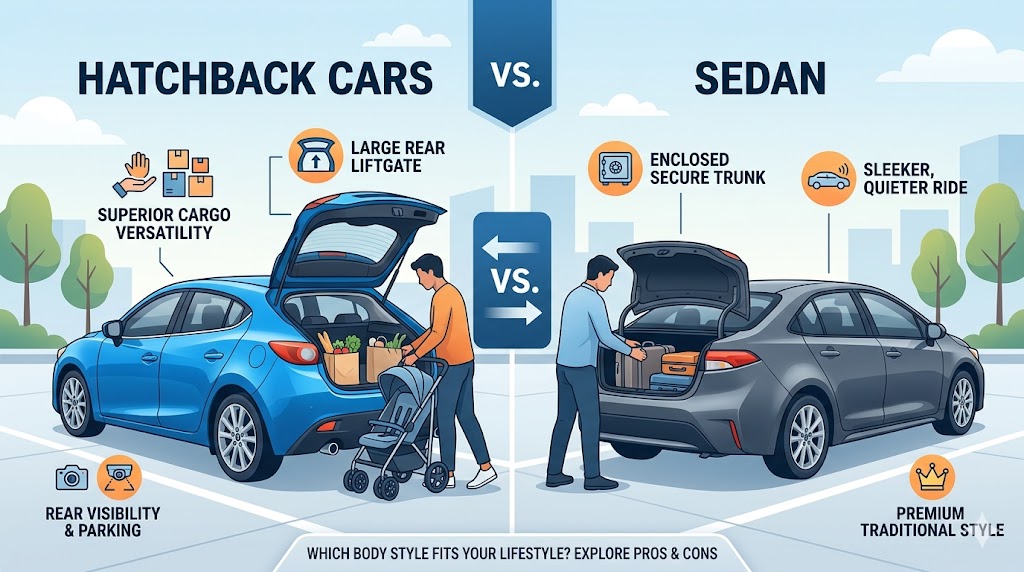
When you look at hatchbacks and sedans, it’s not just about the design. The question is, which one is better for your day-to-day activities. Most people are not searching for the “perfect” car; they just want something that makes every day driving easier. We’ll look deeper into this: hatchback vs. sedan.
What is a hatchback?
A hatchback is a car body style with a back door that swings upward and provides access to the cargo area. The trunk is not separated from the cabin, as in sedans, so that the space inside can be used flexibly. With this, you can carry large items and customize the space to your daily routine.
Main features of a hatchback:
Rear hatch door instead of trunk
The back door opens and provides access to the cargo space. This is useful when you want to load or offload large items that could be more difficult to put through a separate trunk.
Foldable rear seats for additional storage
The interior of the hatchback contains versatile features such as folding, sliding, and stowing. The cargo area contains durable materials, like plastic and fabric. However, the majority of hatchbacks have rear seats that can be folded down, allow you to create more cargo space.
Compact body design
Hatchbacks are smaller than sedans, which is why it is easier to park in tight corners or malls with little parking.
Easy to load large items
The cargo is so close to the cabin that you can carry items as large as sports equipment or grocery bags with no problems. That versatility is a big selling point over traditional sedans and shapes, as well as the principles, for instance, maneuverability and efficiency.
What is a Sedan?
A sedan is a passenger car in a three-box configuration with separate compartments for engine, passenger, and cargo. That gives a more formal three-box car layout than hatchbacks. Sedans offer a balanced combination of comfort and stability.
Main Features of a Sedan
Separated Closed Trunk
The trunk is separate from the cabin, which can protect the luggage from being damaged and ensure it remains safe and can also reduce the noise from the cargo area.
Fixed Rear Windshield
The rear window is fixed as part of the vehicle body, unlike in a hatchback, which means the rear section is solid and strong.
Extended Body Style
Sedans are longer in the wheelbase. It provides better comfort, stability, and flow on the highways.
More Open Passenger Space
The interior has clearly defined seating positions with enough legroom and comfort for everyone on board. Sedans are built for comfort, structure, and road stability.
Hatchback Cars vs. Sedans: The Differences
When you want to compare hatchback cars vs. sedans, you may be overwhelmed by the features. The main difference is how you use the car. There are some people who need flexibility, some who care more about comfort, and some who just want an easy-to-park vehicle. Here are all the key points so you can tell what really matters.
Features
Size
Hatchbacks are compact vehicles that are easier to cross through congested city streets and parking lots. You don’t need to force the car into tight little spaces.
Sedans are longer, however. They need more space when parking, and a U-turn feels a bit heavier. If most of your driving is done around town, a hatchback will just make life easier.
Maneuverability
Hatchbacks give you a light, quick feel on the road. Changing lanes, making sharp turns, or squeezing into a tight spot on the right is no problem. There is nothing wrong with sedans’ handling; they just need a bit more effort.
Cargo and Storage
Hatchbacks make carrying things easy. They have big lift gates that swing up, so you get lots of vertical space. If you need more room, just fold down the back seats.
Sedans work differently. Their trunks are separate, so they’re more private and quieter. But you don’t get much height or a big opening, which means fitting larger items can be quite difficult.
Ride Comfort
Sedans feel better on long drives. They give you a smoother ride, thanks to things like their separate trunk and suspension that’s built for comfort. Hatchbacks, on the other hand, are easier to handle around town.
You get better access to your cargo, and extra headroom, so they’re more flexible for city life even though you may notice more road noise.
Fuel Efficiency
Hatchbacks and sedans both do well when it comes to fuel efficiency, but the real differences come down to the specific model and not the type of car. In most cases, hatchbacks handle city driving a little better because they’re smaller and lighter, so they use less gas in traffic.
Sedans get a slight edge on the highway because of their aerodynamic shape. Still, the gap isn’t huge, and it depends on which car you’re looking at.
Style and Design
Sedans stick to the classic “three-box” shape, so you get a separate trunk and that traditional, polished look. Back passengers usually have more legroom, too. But hatchbacks go with a “two-box” design and a rear lift gate.
They’re a lot more versatile when it comes to cargo, easier to park in tight city spaces, and look a bit sportier and more modern.
Road Presence
Sedans stand out more because of their length and formal design. Hatchbacks feel a bit more agile and are built for city life. They’re compact, easy to maneuver, and have a more urban, modern style. Sedans, though, have a longer wheelbase and a lower stance, giving off that timeless, sophisticated feel.
Flexibility
Hatchbacks are great if you need space; they’ve lift gates and folding back seats. You can pull bigger or odd-shaped material without much trouble. Sedans really focus on comfort and classic style. Their separate trunks keep your belongings out of sight and make the ride a bit quieter.
If you live in the city, hatchbacks fit in better and handle tight spots well. Sedans come off as more polished and refined.
Ease of Use
Hatchbacks just make life simpler; you can squeeze them into tight parking spots, throw loads in the back through a big rear hatch, and deal with difficult cargo without much trouble. Sedans give you more privacy in the back and a smoother, more polished ride.
When you’re stuck in city traffic, hatchbacks feel quicker and easier to handle. Sedans hold the road better when you’re picking up speed. _
Compact Movement
Compact hatchbacks focus on practicality and are easy to handle in city traffic. They have a rear lift gate that gives you quick access to the cargo area, and folding down the seats means you get more space when you need it.
Sedans put comfort and security first. The separate trunk keeps your belongings out of sight, gives passengers more privacy in the back seat, and usually blocks out road noise better than a hatchback.
Comfort
Sedans make long drives more comfortable. You get more space to stretch your legs in the back, the ride feels smoother, and things stay quieter inside. On the flip side, hatchbacks are all about utility.
There’s extra headroom, it’s easy to load things in the back due to the lift gate. Both types handle passengers just fine.
Structure
Hatchbacks have a “two-box” design, which means the engine sits in front and the passenger and cargo areas share the same space. You open the back with a lift gate that swings up.
Sedans are a bit different; they split the car into three areas: engine up front, people in the middle, and a trunk in the back.
Hatchbacks give you more flexibility, especially when you need to load bulky things; also, you get more room for taller items. Sedans keep your belongings tucked away in a separate trunk and typically give you a quieter, smoother ride.
Drivability
Hatchbacks are great if you’re driving through the city; they’re smaller and lighter, so you can squeeze into tight parking spots and handle busy streets without much stress. Sedans feel steadier and quieter when you’re cruising at higher speeds because of their longer wheelbase and the separate trunk.
If you need to carry different kinds of cargo, hatchbacks make that pretty easy. But when it comes to sitting in the back seat, sedans have more room and comfort.
Pros of Hatchbatch
- Flexible Cargo Space
This is the biggest advantage. Without a separate trunk, you can fold the back seats down to create a broad, usable area. It allows you to transport larger items far more easily than a sedan.
- Easier to Drive in Tight Areas
Hatchbacks are normally small, which is suitable when it comes to parking and maneuvering through traffic. You don’t need as much room to turn or squeeze to park your car.
- Better Fuel Efficiency
Because they’re lighter, hatchbacks have better gas mileage. It is the small difference that makes all the difference when you drive every day.
Cons of Hatchbacks
- Less rear seat space
Most hatchbacks are small, so the legroom in the backseat can feel overcrowded, especially if you’re tall.
- More Cabin Noise
As the boot is not a separate space, external noise can infiltrate more readily inside.
- Limited Privacy for Luggage
There’s no lockable trunk, so belongings in the back are more exposed unless you put a cover on them.
- Not Stable at High Speeds
Hatchbacks feel lighter on highways, especially when driving fast compared to sedans.
- Less formal appearance
They are practical, but they don’t always have the same ‘executive’ look that people expect from a sedan.
Examples of Hatchback Cars
Here are some popular hatchback models:
- Honda Civic Hatchback
- Toyota Corolla Hatchback
- Volkswagen Golf
- Ford Focus Hatchback
- Hyundai i30
- Kia Rio Hatchback
- Peugeot 208
- Mazda3 Hatchback
Sedan Pros and Cons
Pros of Sedans
Better Ride Comfort
Sedans are built with a longer wheelbase, which helps smooth out bumps and rough roads. The drive feels more stable, especially at higher speeds.
Quieter Cabin
The separate trunk design helps reduce road noise. You may notice this when on a long trip.
Balanced Handling
Weight distribution in sedans is usually more even, giving better control on highways and during turns.
More Refined Appearance
Sedans have a clean, structured look. It gives that more formal and presentable look.
Secure Trunk Space
Since the trunk is separate, it hides your luggage and also protects them instead of an open cargo area.
Cons of Sedans
Limited Cargo Flexibility
The fixed trunk space means you can’t easily carry large or oversized items.
Less practical for mixed use
If you regularly carry different types of loads, the sedan design can feel restrictive.
Longer Body Size
Parking and maneuvering in tight spaces can take more effort unlike smaller cars.
Lower Ground Clearance (in many models)
Some sedans struggle on rough or uneven roads than larger vehicles like an SUV.
Related Post:FWD vs AWD: Which Drivetrain is Actually Better for You?
Examples
Here are some popular sedans across different categories:
- Honda Civic
- Toyota Corolla
- Honda Accord
- Toyota Camry
- Hyundai Elantra
- Nissan Altima
- Mercedes-Benz C-Class
- BMW 3 Series
- Kia K5
- Volkswagen Passat
FAQs
- What is a hatchback?
A hatchback is a car with a rear door that opens upward, giving easy access to the cargo area. The seats often fold down for extra space when needed.
- How is a sedan different from a hatchback?
Sedans have a separate trunk and a longer body. It gives a smoother ride. On the other hand, Hatchbacks are more flexible. They’re perfect for city driving.
- Are hatchbacks good for long trips?
Yes, they can handle long drives, but sedans usually offer a quieter and more comfortable ride.
- Should I choose an SUV or a hatchback?
SUVs are great for space, off-roading, or family trips. Hatchbacks are better for city driving, easy parking, and fuel efficiency.
- Do hatchbacks save on fuel?
Most hatchbacks are lighter than sedans or SUVs, which usually means they consume less fuel in daily driving.
Conclusion
Hatchbacks are small, flexible, and easy to park. For sedans, they’re built for comfort, especially on longer drives where you just want to sit back and relax.
Sedans have that tough, dependable vibe, and they fit just about everything without making you sweat over space. Honestly, what matters most is how the car fits into your everyday life.
Want more car tips and updates? Subscribe now and be part of the conversation.
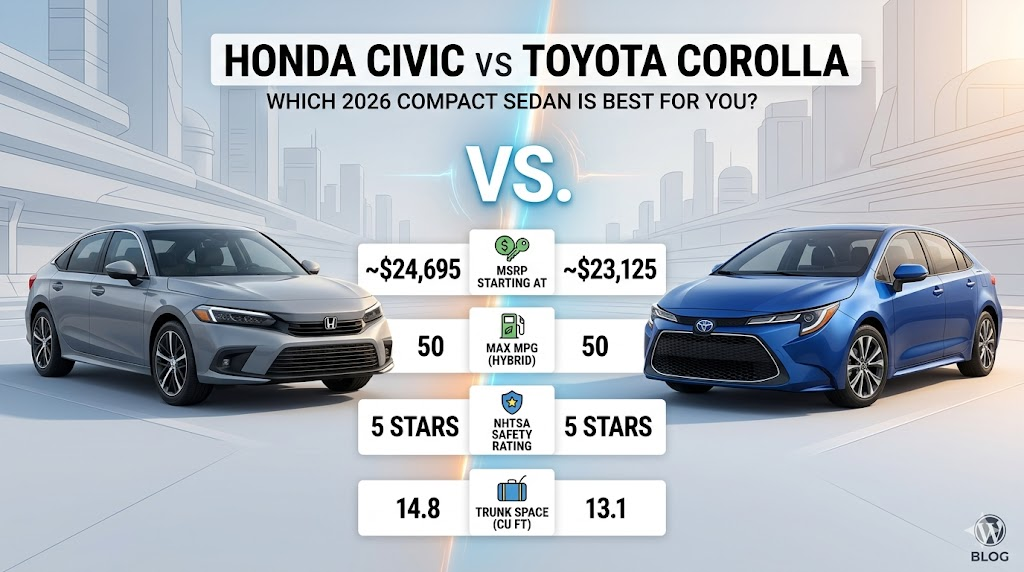
The comparison between the Honda Civic and Toyota Corolla didn’t start today. These are different brands, but intending buyers always like to compare them. Both cars have improved features. But owning a car is not all about features. You need to know how they work.
On major roads, you may notice that there are many Hondas and Toyota Corollas. You know why? The reliability and maintenance costs are low. Should any damage happen to the car, they are available in several auto shops, and all these count.
About the Honda Civic Car
The Honda Civic Sedan and Hatchback rank as the top choices among buyers. Both models have similar powertrain selections.
Honda Civic Models (2020–2025)
Honda Civic Sedan Models
These are the most common Civic models.
- LX (base model)
- Sport
- EX in 2020–2021
- EX-L (some markets or years)
- Touring / Sport Touring (Hybrid in 2025).
In the sedan lineup, they have:
- LX
- Sport
- Sport Hybrid
- Sport Touring Hybrid
Honda Civic Hatchback Models
These have a sportier design.
- LX (previous years)
- Sport
- EX / EX-L (previous years)
- Sport Touring
In recent models (2022–2025), hatchbacks focus more on:
- Sport
- Sport Touring (including hybrid versions)
Honda Civic Coupe (Discontinued)
Available up to 2020
- LX Coupe
- Sport Coupe
- EX Coupe
- Touring Coupe
Note that Honda stopped producing the coupe after 2020.
Honda Civic Si (Performance Trim)
Civic Si Sedan (manual transmission only)
Honda Civic Type R (High Performance)
This is the top-tier performance model.
Civic Type R (Hatchback only)
Honda Civic Hybrid (Reintroduced in 2025)
Models:
- Civic Sport Hybrid
- Civic Sport Touring Hybrid
Civic models from 2020–2025, fall into:
- Sedan (4-door)
- Hatchback (5-door)
- Coupe (2-door; discontinued after 2020)
- Performance models (Si & Type R).
About Toyota Corolla
The Corolla has its own style. It’s always been about being reliable. Newer models run more smoothly, make less noise, and are fuel-efficient compared to older versions, particularly the hybrid ones.
Eleventh Generation (2012–2019)
This generation comes as sedans and wagons.
Twelfth Generation (2018–Present)
Introduced around 2018, this generation expanded the Corolla lineup to include:
- Sedan
- Hatchback
- Estate / Touring Sports (in some markets)
- GR Corolla (high-performance hatch).
Toyota Corolla Trims and Models
Standard Corolla Trims
- Toyota Corolla L: Basic entry-level model
- Toyota Corolla LE: Most common comfortable daily driver
- Toyota Corolla SE: Sportier styling and suspension
- Toyota Corolla XSE: Premium, more features and technology.
Hybrid Versions
- Toyota Corolla Hybrid LE: Base hybrid focused on efficiency
- Toyota Corolla Hybrid SE: Sportier hybrid feel
- Toyota Corolla Hybrid XLE: Premium hybrid with extra features
- Trim names like L, LE, SE, and XSE are used in the U.S., Canada, and some foreign markets.
- Other regions may have different badges, such as GLi, XLi, or Altis.
Honda Civic Features (2020–2025)
Between 2020 and 2025, the Honda Civic transformed from a basic compact car to something more refined. The features include:
Engine and Hybrid Powertrain
The Civic models from 2020 to 2025 have a standard 2.0L 4-cylinder engine. In addition, newer versions include a hybrid system that combines a gasoline engine with electric motors, and delivers up to 200 horsepower. The base engine provides reliable power for daily driving.
On the other hand, the hybrid setup has stronger acceleration and it doesn’t consume much fuel.
Continuously Variable Transmission (CVT)
Since 2020, the Civic has been using a CVT instead of the usual automatic transmission. This system doesn’t shift gears in the traditional sense. It adjusts constantly.
Interior Design and Cabin Layout
Between 2022 and 2025, it featured a streamlined dashboard design with mesh panels that covered the air vents, a higher interior material in all trims. The simplified layout keeps your eyes steady and focused on the road.
Controls are placed where hands naturally reach, reducing the need to look away while driving.
Infotainment System and Connectivity
Modern Civic models come with touchscreen displays. Most are 7-inch to an optional 9-inch version. They include smartphone integration and, in the higher trims, digital instrument clusters. These features are all about convenience.
You can connect your phone and access navigation, music, and calls without separate you needing devices. And the system responds quickly. The Civic keeps things smooth and responsive.
Honda Sensing Safety Suite
Honda has made its safety system standard on most Civic trims. Adaptive cruise control, lane-keeping assist, and automatic emergency braking are included.
These features actively support the driver. One is an adaptive cruise control that keeps a set distance from the vehicle in front, and hills can be easier on passengers on long trips.
Lane-keeping assist also keeps the car centered, particularly on highways. If it senses an impending impact, emergency braking takes over. The aim is not to take over driving but to reduce errors and ease stress behind the wheel.
Suspension and Handling System
A big part of the Civics’ identity is its suspension tuning. Honda understands that balance was the answer. With this feature, the car doesn’t over-bounce on rough roads, and it doesn’t feel loose when you turn. That makes it easier to drive particularly at high speed or on bumpy roads.
Space
The Civic seats five people comfortably. Its back seats are spacious, and the trunk is wide. Also, the hatchback model adds versatility, which means drivers can carry larger items when necessary.
Related Post:Why You Should Never Ignore Wheel Bearing Noise
Toyota Corolla Features (2012–2025)
Engine and Powertrain
In 2012, the Corolla came with a 1.8L engine that had four cylinders and delivered about 132 horsepower. Drivers could choose between a manual and an automatic transmission. Fast forward to 2025, and it featured a more robust 2.0L engine producing up to 169 horsepower.
Essentially, the Corolla provides steady and reliable power. The newer engines offer slight improvements in efficiency and responsiveness.
Hybrid System
Toyota added hybrids to the Corolla lineup, and by 2025, they became a big selling point. These systems blend gasoline engines with electric motors to boost fuel efficiency. On the road, this hybrid setup cuts down fuel usage a lot, especially in traffic.
Moreover, it runs quietly and smoothly. Drivers can switch between electric and gas power automatically.
Transmission System (Manual, Automatic, CVT Evolution)
In 2012, the Corolla included a 4-speed automatic and a 5-speed manual transmission. But as time went by, Toyota switched to CVT systems. This shift increased fuel efficiency.
By the year 2025, most trims had CVTs as standard equipment. The Corolla’s CVT, much like that of the Civic, removes gear shifts, keep rides smooth. Also, it lowers fuel use.
Interior Comfort and Layout
The Corolla’s interior has always made sense. Back in 2012, it had enough space, easy controls, and room for passengers. In 2025, they improved on the interior.
Infotainment and Connectivity
Older models of the Corolla had basic audio system, such as Bluetooth and USB connectivity. Today’s models have bigger touchscreens, smartphone connectivity, and enhanced software systems. The features make connection easy.
Toyota Safety Sense
The safety suites are available on newer Toyota Corolla models. They include lane departure warning, adaptive cruise control, and pre-collision systems, among other things.
These tools are similar to that of Honda’s lineup. However, there is a key difference: Toyota’s approach leans towards caution. Their system opts for stable and predictable actions over quick responsiveness.
Practical Space and Everyday Use
Like the Civic, the Corolla has a five-seater and a usable trunk (roughly 12 to 13 cubic feet, but it depends on the model year).
This asset covers daily life, transportation, shopping, and traveling. Not the biggest in its class, but definitely the most consistent. The back seats also split-fold.
Honda Civic vs Toyota Corolla: The Comparison
Driving Feel
The Honda Civic is more responsive and easy to control. The steering has some weight to it, and the car responds immediately when you turn the wheel.
Engine Performance
The Civic picks up speed faster, especially in its turbo and hybrid versions. It feels more responsive when you need to merge into traffic or pass another car. On the other hand, the Corolla provides a consistent power flow.
It’s not sluggish, but not as responsive as that of the Honda Civic. The Civic delivers performance on demand, while the Corolla offers steady reliability.
Fuel Economy
Corolla (both gas and especially the hybrid) is more fuel efficient. It conserves fuel better regardless of how you drive. The Civic hybrid is efficient too, but it combines power and economy. Corolla wins if you want to save money on fuel. However, if you want performance over fuel efficiency, the Civic is better.
Interior Quality
Civic has a better interior. Its materials are higher-quality, the layout is neater, and it looks modern inside and out. But the Corolla may not feel luxurious, but it’s easy to use, and it’s comfortable, too.
Technology and Infotainment
The Civic offers a more refined experience, with a fast-responding, high-quality display. The Corolla, however, leans more towards simplicity and reliability. Its design might not impress, but it consistently handles tasks well.
While the Civic provides a modern feel, the Corolla cares about performance and reliability. Do you need heavy technology or just something simple like radio, USB, Reverse camera, etc.? This will help you to make your choice.
Reliability
Both cars are solid choices, but the Corolla stands out for its long-term reliability. You don’t have to worry much about wear and tear of parts. Their parts hardly fail. As for Civic, it is reliable but it requires more regular maintenance than the Corolla.
Maintenance Cost
The Corolla has a cheaper maintenance cost. In addition, people go for Toyota because the parts are easy to find, and the service is less expensive, too. The civic parts are also available in aftermarkets, but the prices are high compared to the Honda Civic.
Resale Value
Both cars maintain their value well, though the Corolla often has a slight advantage. Buyers have confidence in its reliability, so demands are high. While the Civic sells easily, too, more buyers usually prefer the Corolla when shopping for a used car. So, it attracts more interest when you put it up for sale.
FAQs
- Which is better: the Honda Civic or the Toyota Corolla?
There isn’t a single “better” option here, and that’s why the Honda Civic vs Toyota Corolla debate keeps going. The Civic is better if you care about driving feel, design, and a more refined experience.
The Corolla is better if you want reliability, lower costs, and resale value. But it depends on your priorities, not the car itself.
- Which car lasts longer, Civic or Corolla?
Both cars can last a long time, but the Corolla is known to last longer especially if proper maintenance is followed.
- Is the Honda Civic worth the extra cost?
The Civic delivers a better driving experience, a more sophisticated interior, and a more modern technology. If those things matter to you daily, the extra expense is worth it. If all you want is a reliable car to get you from point A to point B, the Corolla is far better.
- Which has better fuel economy, the Civic or Corolla?
The Corolla, especially the hybrid version, is typically better for fuel economy. It’s designed to maximize efficiency without requiring any effort from the driver. The Civic hybrid is also efficient, but it balances fuel savings with performance. If your main goal is spending less on fuel, go for the Toyota Corolla.
- Which car is better for daily commuting?
Both work well, but in different ways. The Corolla makes commuting easier because it’s smooth, predictable, and comfortable over long periods. The Civic makes commuting more enjoyable because it feels more responsive and engaging. For long drives, Corolla reduces stress. If you want to enjoy the drive a bit more, the Civic stands out.
Wrapping Up
The Honda vs. Toyota debate doesn’t seem like something that’ll end soon. Although they are different car brands, the two are popular because of their fuel efficiency, available parts, resale value, and affordable maintenance costs.
If you need a car for personal use and want a sporty feel, I recommend a Honda Civic. The Toyota Corolla can withstand everyday driving and can be used for ride sharing. The look is not among the best, but surely one of the most dependable cars.
Still have questions? Drop them in the comment section, and kindly like us on all our social media pages.
Toyota Financial Services, Ford Credit, and Honda Financial Services, allow refinancing and gap insurance. While filling out a form, the dealership may ask if you want Guaranteed Auto Protection (GAP coverage). Don’t be quick to say yes or no if you have no idea what they are talking about. Find out how much gap insurance costs and whether you even need it.
Most buyers at this point hurriedly tick the box without knowing what they just signed up for. Once you agree to the terms and conditions of the coverage, you must keep to the agreement. And some terms you may come across is Guaranteed Auto Protection or Coverage.
What Is Guaranteed Auto Protection (Gap Coverage)
Before we get to the cost, let’s clarify one basic question: What is gap coverage, and why does it keep appearing whenever someone talks about car financing?
In essence, gap insurance covers you for the shortfall between what your standard car insurance pays out after a total loss and what you still need to pay on your loan or lease. It is applied only when the car is declared a total loss or stolen and not found.
Here’s where it gets interesting. Cars apparently don’t retain value the way people think. Once you drive a new car off the lot, its resale value begins to drop. Your loan, however, doesn’t reduce.
You’re still paying interest on the full amount you borrowed. So it’s quite easy to owe more on your car than it is actually worth just a month or two after you buy it. That’s not poor financial planning, but how depreciation works.
“Gap insurance covers the difference between your car’s value and the amount you still owe on your loan. When drivers hear stories of people paying for a car that has already been totaled, they start asking, “How much does gap insurance cost?”
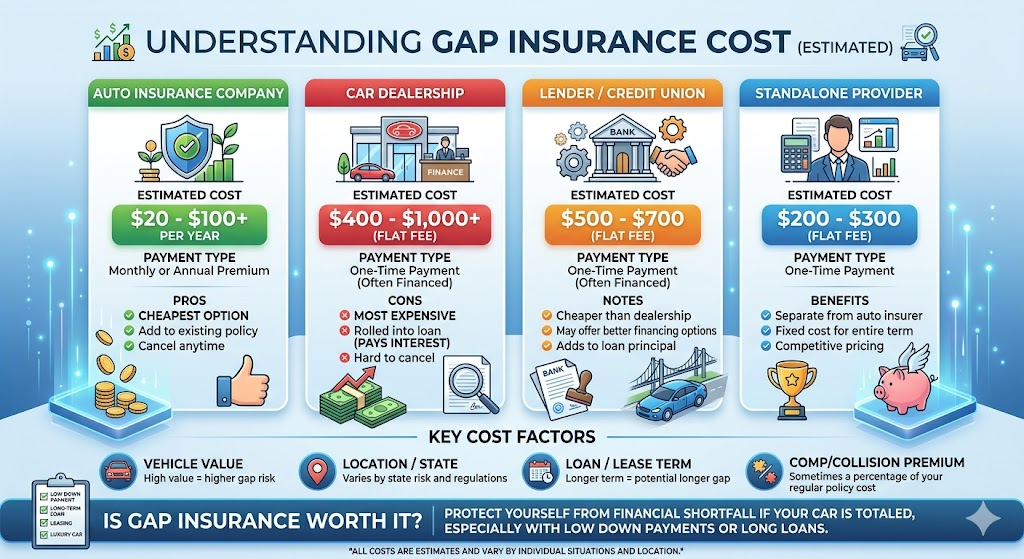
When gap coverage is included in your car insurance policy, most drivers are hit with a fee of $20 to $40 per year at most, which converts to about $2 to $5 per month. It is one of the cheapest add-ons that you can attach to a car insurance policy.
Buying gap insurance from a dealer can cost more. They charge a one-time fee ($400-$800+) added to your loan, rather than a small monthly payment. So, you are paying a premium price for the exact same coverage.
Gap insurance usually costs between $2 and $14 per month, or $24 to $168 annually. Rates depend on your vehicle’s value, loan amount, and state.
How Much Is Gap Insurance per Month with Major Insurers
Gap coverage is calculated differently by insurers. One company might refer to it as “gap insurance,” while another uses the term “loan/lease payoff coverage.” They have the same purpose, but the amount and definition of coverage are different.
Take, for example, Geico, which provides gap coverage in some states and not as part of a comprehensive policy. Progressive has a similar product called loan/lease payoff coverage, but with important distinctions: it rarely covers the entire amount; often covering only the gap up to 25% of the car’s actual cash value. (research yours for the exact percentage).
These coverage thresholds can make a huge difference in your payout when you make a claim.
Your gap insurance premium is calculated with these considerations in mind:
- Vehicle Value: Higher-end vehicles have a greater potential “gap” between their value and loan balance, driving up costs slightly.
- Loan Terms and Amount: The more you financed the car’s cost or the longer your repayment term, the greater the chance you’ll owe more than the car’s worth and the higher your cost.
- Location: Residing in high accident or theft areas may raise your premium.
- Driving History: Although gap insurance is associated with your loan, the car insurers may consider your driving history when determining how much your overall policy will cost. A clean record keeps costs down; a claims history can increase them.
Gap Insurance Cost Through a Dealership vs. an Insurance Company
It’s one of the largest areas where drivers overpay and don’t even know it. You’re already concentrating on interest rates, monthly payments, and the paperwork, so when the dealership presents gap protection, it seems like just another box to check before you drive off in your new car.
Gap insurance is typically offered at dealerships as a one-time fee ($400–$800), which is then added to your auto loan, so you end up paying interest on it for the duration of the loan. This brings the accessory rate much higher than the sticker price.
Or you can buy gap insurance from your car insurance provider for a small additional premium. You get the same basic coverage, but you don’t pay the interest.
The difference in prices can pile up. “It’s cheaper to pay a couple of dollars a month than to pay a few hundred all at once.”
Why Gap Insurance Exists Primarily on New Cars
Most cars lose about 15 to 20% of their value within the first year, sometimes even more, depending on the make and model. That means that a vehicle you paid $30,000 for could realistically be only worth $24,000 or $25,000 by the time you’ve made just under a year of payments.
Nothing is wrong with the car. The car value is only depreciating, that’s all.
When you buy a car using financing, you are repaying the entire cost including the interest. At the initial stage, most of your payment is going toward interest instead of principal. So your vehicle is depreciating fast, but your loan balance is decreasing slowly.
New cars depreciate quickly and often cause a major gap between the value of the car and the loan balance for a long time. Used cars, on the other hand, have already taken that steep initial depreciation hit, so the loan-to-value gap is much smaller.
Do I Need Gap Insurance?
You likely need gap insurance if:
- You financed most of the car.
- Your loan term is longer than 60 months.
- You rolled old debt into a new car loan.
- You made a small down payment.
- You may not need it if:
- You paid cash.
- Your loan balance is already lower than the car’s value.
- You made a large down payment.
So the answer to “do I need gap insurance depends on several factors like the above.
How State Laws Affect Gap Insurance Cost
Gap insurance is not mandatory; some leasing companies and lenders may require you to add this coverage to your finance contract if you are not able to show proof of insurability.
Rates for insurance also vary by region. Those driving in areas that see a lot of claims often pay more, as total-loss claims are more frequent.
So your monthly cost in Texas or California, for instance, could vary even if you had the same car model.
What Gap Insurance Does Not Cover
Gap coverage is extremely particular. It simply covers the difference between the amount you owe on your loan and the actual value of your car in the event of a total loss.
It does not cover:
- Engine failure
- Repairs
- Missed loan payments
- Late fees
- New vehicle replacement
Gap Insurance vs. Loan or Lease Payoff Coverage: Are They the Same?
A few insurers, like Progressive, don’t call it “gap insurance.” They refer to it as loan or lease payoff coverage. It sounds different, but it essentially does the same thing: If your vehicle is destroyed or stolen, it pays the gap.
There is a limit, though. It’s usually about 25 per cent over what the car is worth. That’s fine for most people, but if you owe way more than your car is worth, it won’t cover even half your liability. It’s not exactly the same as gap insurance, but it is comparable.
For instance, if your loan was high and your down payment was low, you could still owe a balance even with this coverage.
When Gap Insurance Stops Being Useful
Gap insurance is not forever.
There’s no longer a gap to insure once your loan balance is less than the market value of your car. Gap insurance is only relevant while your vehicle loan balance is less than the market value of the car. It’s simple to get gap insurance when you buy a car, but many drivers fail to cancel it afterwards.
Months or years later, they don’t know they are still paying for the coverage they no longer need.
Call your insurer to end the monthly fee. It’s a little bit of savings, but with time, it all adds up. And it’s just nice to know that you aren’t paying for something you don’t need to. Gap insurance only provides value during the first few years of a loan or lease; beyond that, it’s extra, and it’s safe to cancel it.
Related Post:Dashboard Indicator Lights Meanings Explained
Factors That Change Gap Insurance Cost
Insurers look at risk and loan structure.
Key factors include:
- Loan-to-value ratio
- Vehicle depreciation rate
- Loan length in months
- Whether the car is leased or financed.
Luxury vehicles and fast-depreciating cars often come with slightly higher premiums.
Why Some People Think Gap Insurance Is a Scam
There are many drivers who will tell you gap insurance is a waste of money. For instance people that:
- Never had a total loss
- Paid off their loan early
- Or had enough equity to start with.
For example:
Car value: $20,000
Loan balance: $25,000
Accident total loss payout: $20,000
If you don’t have gap insurance coverage, you’ll owe $5,000 out of pocket.
The policy covers that gap, and then pays off the loan.
Should You Buy Gap Insurance From the Dealer or Your Insurance Company?
Dealers get commission on the add-ons. Gap coverage is priced by the insurance company as a policy add-on.
So dealership gap insurance is usually several times more expensive for comparable coverage. This is one of the simplest methods by which buyers overpay when financing a car.
When you’re shopping around, always check your insurer first.
How Gap Insurance Works With Used Cars
Most people think gap insurance is for a new car and not a used one, and this is not true. When you have a new car, depreciation hits the hardest right in the first couple of years, so gap coverage is typically most beneficial during that early ownership window.
With a used car, a large part of that value drop has already taken place by the time you buy it. This means that the amount of the loan and the market value of the car are closer in value, so the “gap” is smaller to begin with.
However, there are scenarios where it is worth it to get gap coverage on a used car. Even with used vehicles, you can still owe more than its worth if you financed close to the full price, took a long loan term, or rolled over negative equity from a previous car.
Gap coverage is the one type of insurance that can prevent you from owing money for a vehicle you no longer own.
The timing, however, is what’s different. Used cars reduce the gap quickly as you pay and the value of the car holds firm. So while gap insurance will still help you, you may only need it for a shorter period compared to someone who just drove a brand-new car off the lot.
How Long Should You Keep Gap Insurance?
Most financial advisors suggest that you keep gap insurance until:
- Your loan balance drops below market value.
- Or you refinance to shorter terms.
And that’s because most drivers hit this between the 18- and 36-month mark of their loan term. For the most part, it is safe to remove them after that.
Average Gap Insurance Cost Compared to Other Car Expenses
Typical costs are:
Expense Monthly Cost
- Fuel: $120–$250
- Insurance $80–$180
- Car payment: $300–$600
- Gap insurance: $2–$14.
Final Thoughts: Is Gap Insurance Worth the Cost?
Car insurance is a minor add-on, but it’s essential since it covers the difference between loan payments and the depreciation of the car. “Once your car is totaled, you are exposed to huge financial risk since the value of the car is depreciating faster than you’re paying off the loan.
GAP insurance is an asset if you have a big loan, lease your car, or own one that depreciates rapidly. But if you bought it outright, or you owe less than what the car is worth, you don’t need it; that will be an unnecessary expenditure.
-

 Uncategorized11 months ago
What is a Good Mileage for Used Car ?
-

 Uncategorized11 months ago
Why does my car shake when I brake?
-

 Maintenance & Repairs11 months ago
Car Radiator Repair Cost
-

 Driving Tips10 months ago
Catalytic Converter Transmission Cost
-

 Maintenance & Repairs9 months ago
What Does an Intercooler Do?
-

 Driving Tips8 months ago
Engine Knocking Fix: Why Your Car is Pinging and How to Save Your Pistons
-

 Maintenance & Repairs9 months ago
Does Engine Oil Expire? How to Tell if That Old Bottle in Your Garage Is Still Safe
-

 Maintenance & Repairs9 months ago
Reasons Your Car Won’t Start or Crank (and How to Fix It Fast!)